
The pattern
Some recursive functions wrap their self-call in an associative operator.
1
2
3
4
fun countDown(n: Int): Int {
    if (n == 0) return 0
    return 1 + countDown(n - 1)
}
countDown(n - 1) is not in tail position because 1 + wraps the result. -Xwasm-enable-tail-calls cannot help, and tailrec rejects this shape. On V8, the function overflows around depth 10,000.
PR #16 adds WasmAccumulatorRecursionLowering, which rewrites this into accumulator-passing form so the self-call lands in tail position.
The transform
The compiler generates a private $accum helper that threads the pending operand as an extra parameter.
1
2
3
4
5
6
7
8
9
10
11
12
13
14
// Original
fun countDown(n: Int): Int {
    if (n == 0) return 0
    return 1 + countDown(n - 1)
}

// Generated helper
private fun countDown$accum(n: Int, acc: Int): Int {
    if (n == 0) return acc + 0     // base case folds the accumulator in
    return countDown$accum(n - 1, acc + 1)  // tail position
}

// Original is rewritten to delegate
fun countDown(n: Int): Int = countDown$accum(n - 1, 1)
The self-call in countDown$accum sits in tail position, so WasmTailCallLowering emits return_call. After the transform, countDown(1_000_000) runs in constant stack.
Supported operators
The lowering targets two categories.
Commutative operators on Int and Long require only one accumulator because a ⊕ b = b ⊕ a. The operand can appear on either side of the recursive call.
| Operator | Type | Example |
|---|---|---|
+ | Int, Long | return n + sumTo(n - 1) |
* | Int, Long | return n * factorial(n - 1) |
and | Int, Long | return maskChain(n - 1, bit) and bit |
or | Int, Long | return maskChain(n - 1, bit) or bit |
xor | Int, Long | return xorChain(n - 1, bit) xor bit |
String.plus is associative but not commutative. The lowering handles it for one-sided patterns by preserving operand order.
1
2
3
4
fun repeatStr(s: String, n: Int): String {
    if (n == 0) return ""
    return s + repeatStr(s, n - 1)  // right-recursive: operand on the left
}
The generated helper accumulates from the left, building (((seed + s) + s) + s), which produces the same result as s + (s + (s + seed)) because String.plus is associative.
1
2
3
4
private fun repeatStr$accum(s: String, n: Int, acc: String): String {
    if (n == 0) return acc + ""
    return repeatStr$accum(s, n - 1, acc + s)
}
Performance
kotlinx-benchmark 0.4.17 in a standalone project, Kotlin 2.5.255-SNAPSHOT, Node.js v24.12.0 (V8 13.6). 5 warmups, 10 iterations, 1 second each. AccumulatorIntro.kt measures three accumulator patterns at three depths.
Throughput in operations per second, higher is better. ON / OFF is the ratio.
| pattern | depth | OFF | ON | ON / OFF |
|---|---|---|---|---|
| Int addition | 100 | 12,292,124 | 25,305,993 | 2.06 x |
| Int addition | 1,000 | 571,306 | 2,801,226 | 4.90 x |
| Int addition | 10,000 | 47,150 | 253,001 | 5.37 x |
| Int multiplication | 100 | 7,732,476 | 8,709,136 | 1.13 x |
| Int multiplication | 1,000 | 563,647 | 964,255 | 1.71 x |
| Int multiplication | 10,000 | 54,915 | 102,386 | 1.86 x |
| String concatenation | 100 | 997,204 | 1,103,108 | 1.11 x |
| String concatenation | 1,000 | 90,058 | 106,330 | 1.18 x |
| String concatenation | 10,000 | 5,426 | 5,767 | 1.06 x |
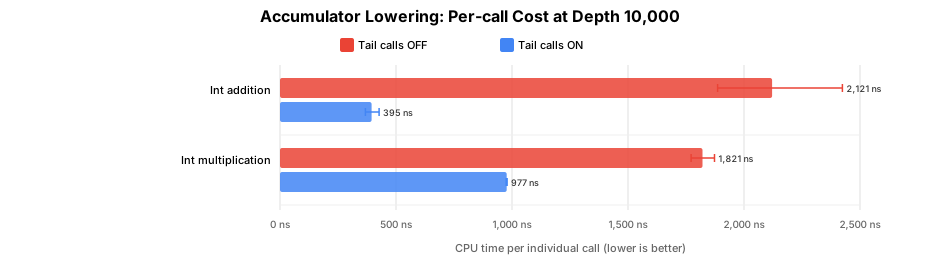
- Int addition shows the largest gain at 5.37x because the per-step cost is dominated by the recursion overhead that the lowering eliminates. Multiplication follows the same trend at 1.86x.
- String concatenation shows only 1.06x at depth 10,000 because the
String.plusallocation dominates per-step cost, making the recursion overhead a negligible fraction. - All three patterns survive depth 1,000,000 with the lowering enabled. Without it, they overflow the V8 Wasm stack around depth 14,000.