
Overview
Tail Modulo Cons (Bour, Clément, Scherer) rewrites recursion whose result feeds a constructor into destination-passing style, turning the recursive call into a true tail call. OCaml 4.14 shipped this as [@tail_mod_cons]. PR 14 brings the same transformation to Kotlin/Wasm as @kotlin.wasm.TailModCons.
What TMC does
1
2
3
4
5
6
7
class Cell(val value: Int, var next: Cell?)

@TailModCons
fun chain(n: Int): Cell? {
    if (n == 0) return null
    return Cell(n, chain(n - 1))
}
chain(n - 1) is not in tail position because its result is wrapped in the Cell constructor, so -Xwasm-enable-tail-calls alone cannot help. On V8, this overflows around depth 10,000.
@TailModCons rewrites this into destination-passing style (DPS). Instead of returning a constructor that wraps the recursive result, the caller allocates the constructor first with a null placeholder in the recursive field, then passes the allocated object as a “destination” to the recursive call. The recursive call fills the placeholder via struct.set and tail-calls itself with the next destination. The compiler splits the function into a wrapper and a $tmcDps helper.

1
2
3
4
5
6
7
8
9
10
11
12
13
14
15
// generated wrapper
fun chain(n: Int): Cell? {
    if (n == 0) return null
    val head = Cell(n, null)          // allocate with placeholder
    chain$tmcDps(n - 1, head)         // pass the placeholder's owner
    return head
}

// generated DPS helper
private fun chain$tmcDps(n: Int, dst: Cell) {
    if (n == 0) return                // base case: placeholder stays null
    val cell = Cell(n, null)          // next cell, again with placeholder
    dst.next = cell                   // fill previous placeholder (struct.set)
    return chain$tmcDps(n - 1, cell)  // tail call (return_call)
}
The self-call in chain$tmcDps is in tail position, so the compiler emits return_call. This emission is unconditional, independent of -Xwasm-enable-tail-calls, because the DPS helper cannot guarantee constant stack without it.
The detection looks for return Constructor(args, f(args)) in the IR. When the TMC site is inside a when or if expression, the return wraps the entire when, not the constructor. The compiler normalizes return when { ... } into per-branch returns first so that each branch is visible as an IrReturn.
1
2
3
4
5
@TailModCons
fun buildList(n: Int): WhenCell? = when {
    n <= 0 -> null
    else -> WhenCell(n, buildList(n - 1))  // detected after normalization
}
The transform handles mutual recursion. When multiple @TailModCons functions form a cycle where each member wraps a call to another member in a constructor, the compiler generates a DPS helper for each function. Each helper tail-calls the callee’s helper, forming a cycle of return_call instructions that runs in constant stack.
1
2
3
4
5
6
7
8
9
10
11
12
13
14
15
sealed interface IList
class ConsA(val head: Int, val tail: IList?) : IList
class ConsB(val head: Int, val tail: IList?) : IList

@TailModCons
fun mutualA(n: Int): IList? {
    if (n == 0) return null
    return ConsA(n, mutualB(n - 1))  // wraps mutualB's result in ConsA
}

@TailModCons
fun mutualB(n: Int): IList? {
    if (n == 0) return null
    return ConsB(n, mutualA(n - 1))  // wraps mutualA's result in ConsB
}
The compiler groups annotated functions into strongly connected components of the call graph. Each SCC forms one DPS cycle. The cycle size is not restricted. The same code path handles a 2-function cycle A→B→A and a 5-function cycle A→B→C→D→E→A.
Performance
The benchmark measures the DPS transform on a linked-list construction.
1
2
3
4
5
6
7
8
9
10
@TailModCons
private fun chainTmcImpl(n: Int): Cell? {
    if (n == 0) return null
    return Cell(n, chainTmcImpl(n - 1))
}

private fun chainPlainImpl(n: Int): Cell? {
    if (n == 0) return null
    return Cell(n, chainPlainImpl(n - 1))
}
| depth | plain recursion (ops/s) | TMC (ops/s) | TMC / plain |
|---|---|---|---|
| 100 | 11,034,353 | 24,763,935 | 2.24x |
| 1,000 | 492,045 | 2,491,851 | 5.06x |
| 10,000 | 48,051 | 244,322 | 5.08x |
| 1,000,000 | stack overflow | 2,448 | - |
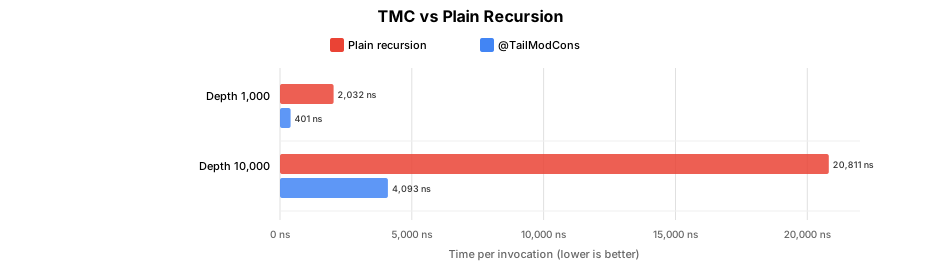
TMC is 2 to 5 times faster than plain recursion at every depth, including the shallowest. The return_call self-loop eliminates frame allocation and teardown, which outweighs the cost of the null-placeholder allocation and struct.set fill.
Environment for reproduction. Apple M1 Pro, Node 26.2.0, kotlinx-benchmark with 5 warmup and 10 measurement iterations of 1 second each.
Applicability
TMC rewrites recursion whose result feeds a constructor. In OCaml, building a list by consing is the default.
1
2
3
let rec map f = function
  | [] -> []
  | x :: xs -> f x :: map f xs   (* tail modulo cons *)
Kotlin developers build the same structures with mutable collections. For example, Apollo’s GraphQL parser Parser.kt builds its AST nodes with buildList. The shape that TMC targets does not appear in this style.
1
2
3
4
5
6
7
private fun parseDirectives(const: Boolean): List<GQLDirective> {
    return buildList {
        while (token is Token.At) {
            add(parseDirective(const))
        }
    }
}
The shape partially appears in mutual recursion. In square/wire’s protobuf option parser, readKindAndValue wraps the results of readMap and readList in a KindAndValue constructor.
1
2
3
4
5
6
7
private fun readKindAndValue(): KindAndValue {
  when (val peeked = reader.peekChar()) {
    '{' -> return KindAndValue(MAP, readMap('{', '}', ':'))  // TMC shape
    '[' -> return KindAndValue(LIST, readList())              // TMC shape
    // ...
  }
}
However, extending TMC to mutual recursion cycles requires every edge in the cycle to be in tail or TMC position. The backward edge from readList back to readKindAndValue accumulates results inside a while(true) loop, making it non-tail.
1
2
3
4
5
6
7
8
9
private fun readList(): List<Any> {
  val result = mutableListOf<Any>()
  while (true) {
    val option = readKindAndValue()  // non-tail: result is accumulated and not returned
    result.add(option.value)
    // ...
  }
  return result
}
The same structure appears in every parser cycle found in the survey. A single non-tail edge in the cycle is enough to prevent the transformation, since frames accumulate at that edge regardless of what the other edges do.